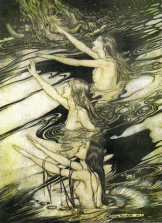
This site is an exploration of the heroic view of the world, and of a heightened sense of reality. It is a long-term project, and so at any point it will be
incomplete. If you visit and find less
than you hoped for, return at a later
time, and perhaps there will be more.
Pages: The first area covered is religion, the ultimate heightened reality--in this case, Asatru, the ancient Norse religion reborn in the modern world. Another page is dedicated to poetry, and especially the poetry magazine, Ship of Fools. Other pages are dedicated to our novel, the cover pictured below. Sword and Sorcery: Past covers the Arthur and Charlemagne cycles of Medieval romance and Spenser's Faerie Queene. Sword and Sorcery: Modern covers such modern writes as Edgar Rice Burroughs and the John Carter of Mars series, Robert Howard and the Conan the Barbarian books, Fritz Leiber, John Norman and the Gor novels, Sharon Green, and others as we have time to deal with them.
There has been yet another overhaul of this page, which includes creating a Mythosphere index page, and breaking the block of links below into a series of blocks.
This is the cover as we originally conceived it. It is altered a little in the final version, published by
Third Milleneum Publishing (http://3mpub.com) You can read more about it there. There are also links from here to pages with information about the characters and setting, as well as a call for creative writers to contribute to a growing imaginative world. To order go to:
We have chosen this picture to represent Sword & Sorcery of the past. I am not sure that it represents any particular scene, but it catches the spirit of the imaginary world of King Arthur, the Faerie Queene, and the emperor, Charlemagne. There is a spiritual atmosphere here quite different than in the more blatently violent and sexual atmosphere of modern Sword & Sorcery.
This is a picture of the Norse god, Thor, the great patron of the common man, with hammer and goat drawn chariot. The religion which had dominated north-western Europe for over a milleneum was supplanted during the Middle Ages by Christianity, but is back and rapidly growing. Why settle for one god when you can have several dozen?
This verson of The Ship of Fools by Hieronymous Bosch did not come out so well. The Ship of Fools is an archetypal
image. Besides the painting, there is a book of poems, a novel, and a movie as well as our magazine with this title. It was chosen for the magazine because poetry is an unworldly, and ill-paying, but demanding activity senseless to the purely practical. And the magazine is a vessel for poets and poetry.
I'm not sure what went wrong with the picture, but I will fix it as soon as I have time. It is a detail of the same painting as the cover picture, and is meant to go with About Mythosphere. This link has a map, a family tree and various background information about the setting and characters for anyone interested in contributing their own stories, or who is simply interested in detail.
This cover by Boris is a fair enough illustration of modern Sword & Sorcery literature. It is a bit more static than most such pictures, but promises action in the future, and is filled with sexual imagery, both blatent and subliminal--a nearly naked woman on a horse and holding a sword is certainly suggestive. Female warriors have always been popular, but Medieval ones tended to wear armor; this one lacks even a chain mail bikini.
This link is a link to our friend Brenna's Zen Witch site. It is a large site with a lot of info very attractively laid out--everything you need to know to be a witch. Wicca is another less familiar approache to religion. At times wiccans and asatru are united against a largely hostile world. At others, asatru see wiccans as fluffy bunnies, and wiccans see asatru as arrogant bullies. All three views probably have some truth. Here is the link:
All the links are listed below, including those listed already on the bar to the left. Originally these were set up as a single block, but that arrangement became increasingly unwieldy. Therefore, the links have been divided into a series of blocks, each with its own index.
Asatru
A large part of our second novel, Murder in Mythosphere is now complete, and we have created a page for it with a passage for which this picture is a very good illustration. To reach the page, use the button below.
a. Fantasy
This is the index page for fantasy works. Aside from a short introduction and links, it
has essays on three great comic book artists and their works. This whole section now
looks a little skimpy since the Mythosphere material was broken away from it, but I'm
sure it will grow.
b. Swordpast (Sword & Sorcery of the Past): A page of information on King Arthur and Charlemagne in literature.
c. Swordmodern (Sword & Sorcery: Modern): The first of two pages on modern fantasy, with a lot of information, and some nice gifs. It covers Edgar Rice Burroughs, Robert E. Howard, J.R.R. Tolkein, and Clark Ashton Smith.
d. Swordmodern 2: More recent writers in the field--Fritz Leiber, John Norman, Sharon Green.
e. Ariosto: A page on Ariosto's Orlando Furioso, the most famous work of the Charlemagne cycle. Some nice engravings by Dore.
f. Witches: This page is also included in the Asatru section. An American folktale.
g. The Lady of the Fountain: A modern retelling of a very strange Medieval romance.
Creative Writing
a. Creative Writing: The index page for creative writing.
b. How to Prepare a Manuscript: Pointer on how to prepare a manuscript. Most of the emphasis is on poetry. It is a very down-to-work page, but there is a nice gif of Felix the Cat.
c. Ship of Fools: This is the poetry magazine I edit. It has been around since 1982, and has published many new poets, and some well known ones. The page gives some sense of what it looks like and he sort of things it is likely to accept.
d. Romance: This was written on a whim. It is about the "bodice ripper" historical novel, both the sort written earlier in the century, and the more recent sort.
e. Rhyme: This is my conference keynote speech, "Six Levels of Rhyme," dealing with the art of rhyme in poetry.
f. Death in the Country: A small collection of my poetry dealing with the theme of "death in the country."
g, h,i,j,k.l: Essays on the mechanics of writing poetry.
m. Epigrams: A large collections of my brief poems and epigrams.
n. Saaheerah's Erotic Poetry page--a collection of sexy poetry by Saahirah.
3. Asatru
Index page for pages on Norse myth and religion. It has some information, as well as a translation of the Voluspa, the most important poem of the Elder Edda. And, of course, it has a number of links.
a. Vanir
These are the alternate Norse gods. This is an attractive and informative page.
b. Alcis
A long essay on two divine brothers similar to Castor and Pollux in Greek/Roman tradition.
c. Volsungs
A nice-looking page dealing with the most famous legendary family of the North, and the subject
of Wagner's Ring Cycle.
d. Sigdrifa
A very attractive page. This is a translation of one of the most famous of the Eddas. Besides the
traslation, there is a set of footnotes, and some nice pictures.
e. Farm: Pictures of the family farm, and musings on the relationship of man, the gods, and the land.
f. Trothmoot
An account of a trip to a large, yearly gathering of followers of the Norse religion.
g. Odin & Odin2: Pages dedicated to the chiel of the Norse gods.
h. Jack and the Witches
An American folktale (No doubt English in origin) which includes Odin in his role as Wanderer.
i. Angantyr: A Norse poem about a warrior woman who goes to the burial mound at night to retrieve her father's sword, the work of dwarves.
j. Wayland the Smith Auden's translation of "The Lay of Volund" with some commentary.
k. Rune I & II A page of the surviving rune poems, and a page of modern rune poems.
L. Heroic Poems :Poems based on, or translated from the story of the Volsungs as told in the Edda and saga.
m. Mead: A short page on meadmaking.
n. Skadi: A page on the winter goddess.
o. Grotti: The song of Grotti--translation and critical discussion.
p. Billin: Odin and Billing's Daughter--translation and critical analysis
Mythosphere
a. Gor Revisited
The index page for several pages dealing with the Gor novels. This discussion started as a part of
the Sword & Sorcery: Modern page, but grew out all reasonable bounds.
b. Gor #1
This page deals with issues of censorship, pornography, philosophical issues, and literary value
in the books. Some fairly offensive pictures.
c. Gor #2
This page deals with the books one by one, a brief account of the story and critical comments.
Also, some even more offensive pictures.
d. Gor #3
This page deals with Gor online, a very big subject you will see if you read it.
e. Gor #4
This page is a comparison between the fantasy worlds of Gor and Mythosphere.
f. Sword & Sorcery: Modern #2
This page, also listed under fantasy, has some information about Gor, as well as about works
dealing with similar themes by Sharon Greene.
g. The Greek Slave
This page deals with Hiram Powers' famous statue of a maiden in handcuffs, reactions to it at the
time, and the story that it implies.
a. Mythosphere Index
This page introduces our scifi-fantasy novel, Mythosphere, and the sequal, now in progress,
Murder in Mythosphere.
b. Mythosphere
This was the original Mythosphere page, but has been largely superceeded. It was my first effort
at a webpage, and is a little crude, though its techno appearance makes it interesting looking.
c. About Mythosphere
This page fills in all the details not included in the book--map, family tree, and much else.
d. Murder in Mythosphere
An introduction to the second book, now well underway. It includes a passage of several pages
dealing with a serial killer which may serve as the prologue to that book.
e. Dragon
This visually nice page includes a short passage from Mythosphere about the dragon. When time
allows, I plan a much more elaborate page dealing with serpents and dragons in myth and
archetype.
f. Diana
The page deals with the Greek/Roman goddess, Diana, and with our goddess, Diana, who plays
a very major role in both Mythosphere books.
Fantasy
This counter has now passed 20,000 hits.
Myth and Archetype
a. Myth and Archetype: General index page to this group of pages, and an essay about myth.
b. A Myth of Minoan Crete: Discussion of a story about a riddle, a snake, and rebirth.
c. Snake Tales: Stories relevant to the association of snakes with death and rebirth.
d. Lovecraft and the Cthulhu Mythos: Intorduction to the creator of the Cthulhu Mythos.
e. Hunchbacks and Lovers: The hunchback archetype, and its connection with stories of love.
f. St. Peter, The Phallic Apostle: St. Peter as a phallic archetype.
g. The Lady of the Fountain: A modern retelling of a mythic and archetypal Medieval romance.